
Ev Charge Cost Calculator
Work out what it costs to charge your electric vehicle. Enter the battery size, the charge level you start and finish at, your price per kWh and charger type, and see the cost of the charge, the cost per mile and a comparison with a gasoline car.
- Free to use
- No sign-up
- Runs in your browser
Calculate EV charging cost
EV Charging Cost Tracker
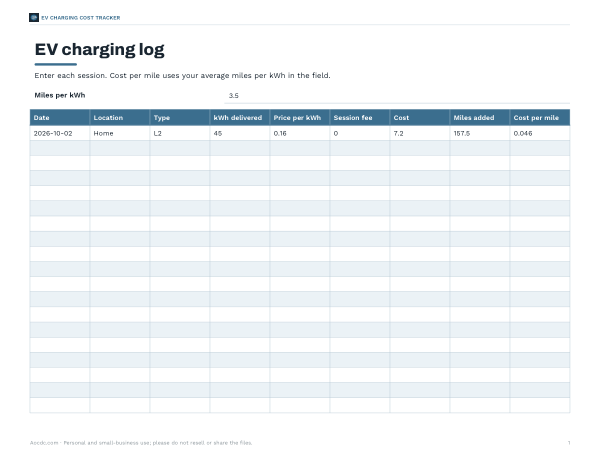
Log every home and public charge, see monthly cost and cost per mile, and compare with a gasoline car.
- Charging log workbook (XLSX, PDF)
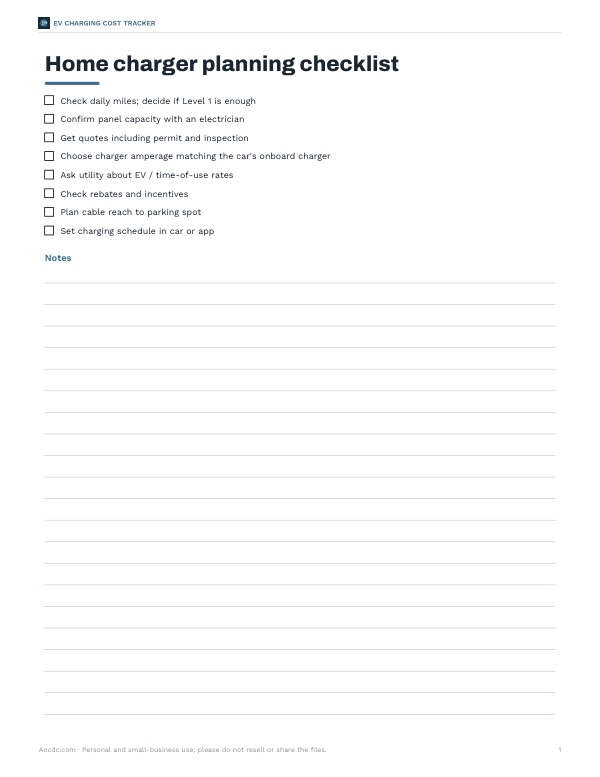
- Home charger planning checklist (PDF, DOCX)
Formats: XLSX, PDF, DOCX. Instant download after payment (link valid 72 hours, up to 5 downloads). AI-assisted: the templates were drafted with AI help and reviewed and laid out before publishing.
$5.00 USD, one-time
- Instant download
- 7-day refund
- Secure checkout by Stripe
7-day money-back guarantee. Full refund within 7 days of purchase, even after you download.
Full refund within 7 days — see the refund policy and license.
Free printables
Single sheets you can print right now, no sign-up. The full pack adds every sheet in one download plus the editable files.
How EV charging cost is calculated
Charging cost depends on how much energy you put into the battery, how much is lost along the way, and what you pay for each kilowatt-hour. The calculator works it out in four steps:
- Energy added = usable battery capacity × (end % − start %).
- Energy from the grid = energy added ÷ charging efficiency, because some energy becomes heat in the charger, cables and battery.
- Cost = energy from the grid × price per kWh.
- Cost per mile = cost ÷ miles of range added (energy added × miles per kWh).
Charging from 20% to 80% of a 75 kWh battery adds 45 kWh. With about 90% efficiency on a home Level 2 charger, you draw 50 kWh from the grid; at $0.16 per kWh that costs about $8.00 and adds around 158 miles of range at 3.5 miles per kWh.
Home, workplace and public charging
| Where | Typical pricing | Speed | Notes |
|---|---|---|---|
| Home Level 1 (120 V outlet) | Your household rate | About 3–5 miles of range per hour | Slow but fine for short commutes |
| Home Level 2 (240 V) | Your household rate; cheaper on EV or off-peak tariffs | About 20–40 miles per hour | Most common home setup |
| Public Level 2 | Free to per-kWh or per-hour fees | Similar to home Level 2 | Watch for idle fees |
| DC fast charging | Often the highest per kWh; sometimes per minute | Fast: typically 10–80% in roughly 20–45 minutes for many cars | Best for road trips |
Home charging is usually the cheapest, especially on a time-of-use plan with low overnight rates. Fast charging is convenient on long trips but can cost two or three times the home price per kWh.
Why charging efficiency matters
Not all the electricity you pay for ends up in the battery. Some is lost as heat in the charger and wiring, some powers the car's electronics and battery conditioning during charging. Losses are generally higher with slow Level 1 charging, because the car's systems run for longer, and in very cold weather, when the battery may need heating. The calculator lets you choose a typical efficiency for each charger type; your car's app or a smart charger can show the real figure.
Worked example: EV versus gasoline
A driver covers 1,000 miles a month in an EV averaging 3.5 miles per kWh, charging at home at $0.16 per kWh with 90% efficiency. That is about 317 kWh from the grid, or about $51 a month — roughly 5 cents per mile. A gasoline car averaging 30 MPG at $3.40 per gallon uses 33 gallons, about $113 a month, or 11 cents per mile. If the same EV driver used only DC fast chargers at $0.45 per kWh, the cost would rise to about $143 a month.
Getting the cheapest charge
- Ask your utility about EV or time-of-use rates and schedule charging overnight.
- Use your car's or charger's scheduling feature so charging starts when rates drop.
- For daily driving, charge to around 80% unless your manufacturer recommends otherwise; it is also gentler on many batteries.
- Precondition the car while plugged in during very hot or cold weather so the grid, not the battery, heats or cools the cabin.
- Compare public networks' membership plans if you fast-charge often.
- Look for free charging at workplaces, shops and hotels.
Understanding miles per kWh
EV efficiency is often shown as miles per kWh or as kWh per 100 miles. Compact EVs can achieve 4 or more miles per kWh in mild weather; larger SUVs and trucks often manage 2–3. Efficiency drops at high speeds, in cold weather, with heavy loads and when using cabin heat. Your car's trip computer shows your average; use it in the calculator for the most accurate cost per mile.
Installing a home charger
A Level 2 home charger typically needs a dedicated 240-volt circuit installed by a licensed electrician, and sometimes a permit. Costs vary widely with the distance from your electrical panel and whether the panel has spare capacity. Some utilities and governments offer rebates or credits for chargers or installation; check what is available locally. For many drivers who travel modest daily distances, a standard 120-volt outlet is enough.
Battery health and charging habits
Lithium-ion batteries age more slowly when they spend less time at very high or very low states of charge, which is why many manufacturers suggest charging to around 80–90% for everyday use and to 100% only before long trips. Frequent DC fast charging is generally fine for modern EVs, which manage battery temperature, but some manufacturers note that relying on it exclusively may accelerate wear slightly. Follow your vehicle manual — lithium iron phosphate (LFP) batteries, for example, are often recommended to charge to 100% periodically for accurate range estimates.
Frequently asked questions
How much does it cost to fully charge an EV?
Battery size × price per kWh ÷ efficiency. A 60 kWh charge from empty at $0.16 per kWh with 90% efficiency costs about $10.67.
Is it cheaper to charge an EV than buy gas?
Usually yes at home rates; public fast charging can narrow or remove the difference.
Why does charging use more kWh than the battery holds?
Some energy is lost as heat and to the car's systems during charging — typically around 10–15%.
What is a good miles per kWh?
Around 3–4 miles per kWh is typical for many EVs; small efficient cars can exceed 4.
Should I charge to 100%?
For daily use many manufacturers recommend around 80–90%; follow your vehicle's guidance.
How do per-minute fast chargers compare?
Divide the session cost by the kWh delivered to get an effective price per kWh, then enter it above.